What are Transferable Development Rights (TDR) in Real Estate? A Complete Guide

Written By
Merawazood Team
Modified On
May 8, 2026
Reading Time
4 Min Read
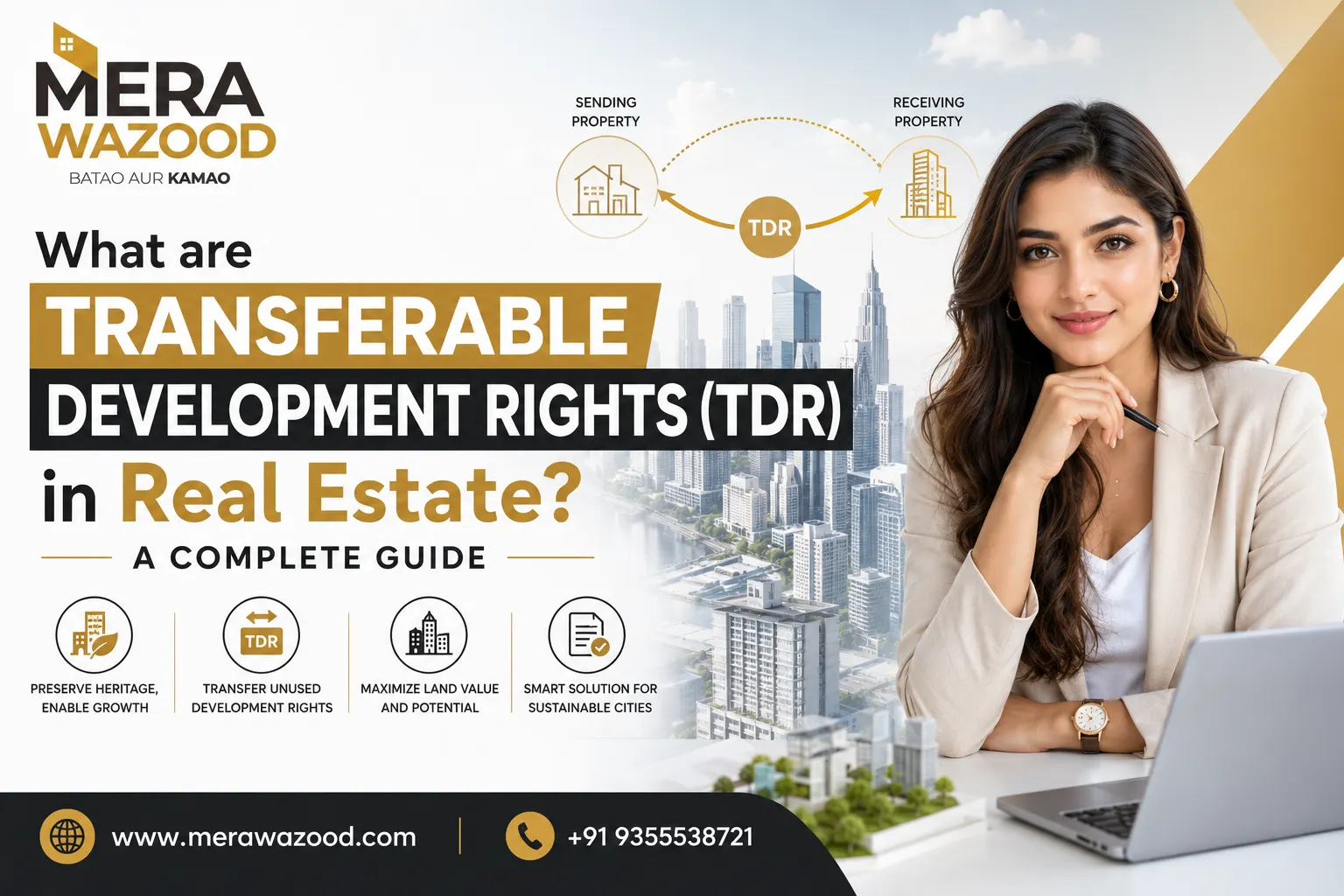
Have you ever heard of a piece of land that could not be developed, yet the owner of the land still made money out of it? That is the magic of Transferable Development Rights or TDR in real estate. It may seem complex, but believe me, when you get to know it, you will realize how strong this idea is to property owners and developers.
In case you are in the real estate business or own a piece of land, knowing TDR may forever alter your perception of the value of land. I will simplify this for you in simple terms.
What is TDR? Understanding the Basics
What is the TDR? In simple terms, Transferable Development Rights is a system that enables you to decouple the development rights of your land and sell them to another person. Imagine it in the following way: you have a piece of land, but the government tells you that you cannot build on it because it is in a conservation area or it is close to a heritage site. Instead of losing all the value of your land, you can "transfer" your right to build to someone else who can use it elsewhere.
The full name of TDR is Transferable Development Rights and the TDR definition is the same as I have just described. However, this is where it becomes interesting: You are paid those rights even though you are not constructing anything yourself.
The Core Concept Explained.
Essentially, TDR in real estate divides property into two valuable components:
- The Land Itself - You still possess the physical property.
- Development Rights - You may sell the right to construct a given quantity on that land.
This division opens up possibilities. A property owner in a protected area may sell his or her development rights to a developer operating in an area where building is permitted. All gain, the original owner receives compensation, and the developer receives additional development capacity.
Types of Transfer of Development Rights (TDR)
Heritage TDR: It is granted to owners of heritage buildings who cannot redevelop their properties due to strict historical preservation laws.
Reserved Plot TDR: It is issued to landowners who hand over their land for public amenities such as schools, hospitals, or parks.
Road TDR: This is provided when private land is acquired for road widening, flyovers, or metro expansion.
Slum Rehabilitation TDR: Contracts were awarded to developers to construct rehabilitation housing for slum dwellers.
How Does TDR Work?
It is easier to understand how TDR works when you follow the process:
Step 1: Identification of Sender Property: A property owner identifies that his or her land is located in a restricted zone (heritage area, green zone, water body protection zone, etc.). This is referred to as the "Sender Property" or the TDR Sending Zone.
Step 2: Development Rights Calculation: The local authority calculates the amount of development that could have been done on that land before the restriction. This amount becomes your "TDR Credit" or "Development Rights Pool."
Step 3: TDR Certificate: The owner of the property applies to the government to be recognized as having the right to develop the property. Upon approval, they are issued a TDR certificate.
Step 4: Finding a Buyer: The TDR certificate holder sells these rights to a developer or property buyer in an area where additional development is allowed (Receiver Property or TDR Receiving Zone).
Step 5: Transfer Implementation: The developer buys the TDR certificate and registers it. They are now able to construct more floor space than the usual regulations.
Step 6: Payment and Registration: The original owner of the property is paid, and both parties register the transaction with the government.
TDR Calculation
Here's where many people get confused. TDR calculation isn't as complicated as it sounds, but you need to understand the formula.
Basic TDR Calculation Formula
TDR Credits = (Potential Built-Up Area - Current Built-Up Area)
Let's walk through a practical example to make this crystal clear.
Real-World Calculation Example
Imagine you own a 1,000 square meter plot in a heritage protection zone in Mumbai:
Before Restriction:
- Permissible Floor Space Index (FSI): 2.0
- Maximum built-up area allowed: 1,000 m² × 2.0 = 2,000 m²
After Heritage Zone Notification:
- New permissible FSI: 0.5
- New maximum built-up area: 1,000 m² × 0.5 = 500 m²
TDR Credit Calculation:
- Lost development potential: 2,000 m² - 500 m² = 1,500 m²
- This 1,500 m² becomes your TDR credit
Earning Potential:
- If TDR market rate = ₹5,000 per m²
- Your TDR value = 1,500 m² × ₹5,000 = ₹75 lakhs
This is how a property owner in a restricted zone can still earn significant value without building anything!
The Two Zones: Sender and Receiver Properties
To truly grasp TDR in real estate, you need to understand the relationship between two property types:
Sender Property (TDR Sending Zone)
- Land that cannot be developed due to government restrictions
- Examples: heritage zones, green belts, water body protection areas, wildlife sanctuaries
- Property owner receives TDR credits for lost development rights
- The land itself still has value (rental, preservation, future value)
Receiver Property (TDR Receiving Zone)
- Property where additional development is permitted
- Located in areas zoned for growth (commercial, residential development zones)
- A developer or builder purchases TDR to build beyond normal limits
- Must comply with FAR, building bylaws, and other regulations, even with TDR
Real Benefits of TDR
For Property Owners in Restricted Zones
- Monetize Restricted Land - Turn protected property into cash without violating regulations
- Fair Compensation - Receive payment for development rights you cannot use
- Retain Ownership - Keep the land while earning from its development potential
- No Active Involvement - No need to become a developer yourself
For Developers and Builders
- Increased Development Capacity - Construct more when there is a shortage of land.
- Cost-Effective Expansion - It is sometimes less expensive than the purchase of new land.
- Regulatory Compliance - Take advantage of legal mechanisms to maximize project potential.
- Competitive Advantage - Develop more dense projects in prime locations.
TDR Market Dynamics: Price Factors
The TDR calculation doesn't end with determining credits; market prices fluctuate based on several factors:
- Location Premium - TDR for premium areas (central business districts) costs more
- Local Demand - High development demand = higher TDR prices
- Zoning Regulations - Areas with higher FSI caps attract expensive TDR
- Market Saturation - Limited receiver zones increase TDR value
- Government Policy - Changes in regulations directly impact pricing
In major Indian cities, TDR rates range from ₹3,000 to ₹15,000+ per square meter, depending on location and market conditions.
How to Use TDR: A Practical Process
For Owners Seeking TDR Credit
- Get your property surveyed and documented
- Apply to the local municipal authority with a land title deed
- Submit a development proposal showing the pre and post-restriction built-up area
- Obtain the official TDR certificate from the civic authority
- Register on the government's TDR trading platform (if available in your city)
- List your TDR credits for sale at competitive rates
For Developers Purchasing TDR
- Identify the receiver property where additional FSI is needed
- Check municipal rules for TDR eligibility and limits
- Source TDR certificates from licensed platforms or direct sellers
- Verify authenticity and registration details
- Execute the legal agreement and register the transfer
- Incorporate TDR into project development plans
- Complete construction within the compliance framework
Common Misconceptions About TDR
"TDR is the same everywhere."
Wrong. Every city has different TDR rules, prices, and availability. Delhi, Mumbai, and Bangalore all have unique frameworks.
"You can sell unlimited TDR."
False. Government regulations cap how much TDR a sender property can generate and how much a receiver property can absorb.
"TDR makes projects automatically profitable."
Not necessarily. Market conditions, location, and project type determine actual profitability.
"TDR is only for big developers."
Incorrect. Individual property owners and small builders also participate in TDR markets.
Challenges and Limitations
Every system has friction points. Here are real challenges with TDR:
- Complex Documentation - Process involves multiple government agencies and paperwork
- Market Volatility - TDR prices can fluctuate based on policy changes
- Limited Receiver Zones - Not all areas accept TDR; availability is restricted
- Regulatory Changes - Government amendments can suddenly affect the TDR value
- Liquidity Issues - Finding buyers for TDR in less developed markets is tough
- Time-Consuming Approvals - Government verification and registration take months
Key Takeaways: The TDR Advantage
Understanding TDR in real estate opens doors for property owners and developers:
- TDR's full form is Transferable Development Rights
- TDR's meaning is selling the development potential that you cannot use
- TDR calculation determines how much development potential was lost
- Both owners and developers benefit from this legal mechanism
- Market rates depend on location, demand, and regulation
- Professional platforms now make TDR trading more transparent and accessible
The bottom line? If you own property in a restricted zone, TDR isn't just a concept; it's actual money left on the table if you ignore it.
Conclusion
Whether you are a property owner who wonders about lost development rights or a developer who wants to have more building capacity, the first step is to understand TDR in real estate.
To property owners and developers seeking professional advice and proven dealings, platforms tailored to real estate professionals can streamline the process and make it transparent. Find reliable partners that are aware of the specifics of TDR calculation and market forces.
Frequently Asked Questions (FAQs)
Q1: Can I sell my TDR multiple times?
No. Once TDR is transferred to a receiver property and incorporated into development, it's exhausted. However, the selling process is one-time.
Q2: What if the government changes FSI rules after I've calculated my TDR?
This varies by jurisdiction. Some cities grandfather existing TDR calculations; others recalculate. Check your local municipal guidelines.
Q3: Is TDR available in all Indian cities?
No. TDR systems have been established in major metros such as Mumbai, Delhi, Bangalore, and Pune. Smaller cities may not have formal frameworks.
Q4: How long does the TDR transfer process take?
Normally, 2-6 months, based on government verification and the completeness of documentation.
Q5: Can agricultural land generate TDR?
Generally no. TDR applies to urban properties. Agricultural land restriction policies differ and don't use TDR mechanisms.
Q6: What happens if my TDR certificate is rejected?
You can appeal with additional documentation or adjust your calculations. Many rejections result from procedural errors that are fixable.
By: SNEHA
Merawazood Team
Author

Recent Post

What is the Difference Between Residential and Commercial Property?
May 8, 2026
How to Start a Real Estate Business with No Money
May 8, 2026
Best Refer and Earn Platform in India for Property Referrals
May 8, 2026
How to Become a Real Estate Referral Partner and Earn Commission in India
May 8, 2026
Confused Between Active Income vs Passive Income? Read This Before You Decide
May 8, 2026
How to Make Multiple Streams of Income: 15 Proven Ways to Build Wealth in 2026
May 8, 2026
Real Estate Broker Commission Rates in India: Who Pays It?
May 8, 2026
Best Website for Earning Money without investment in 2026
May 8, 2026